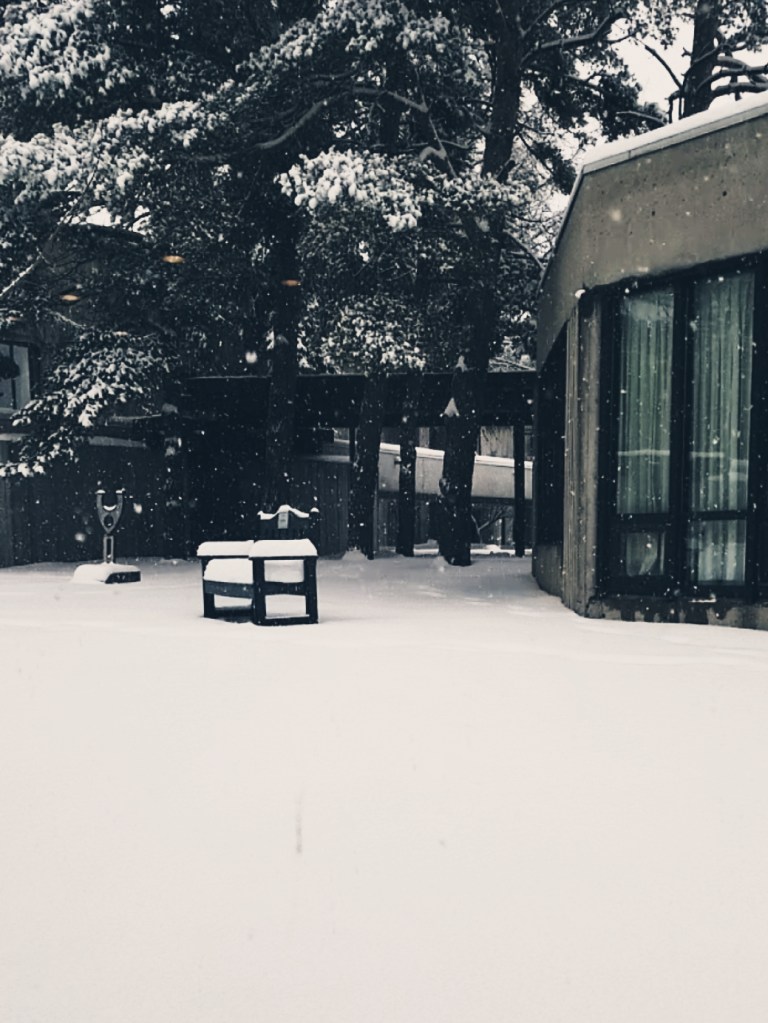
Hey everyone, it is Hudson1002, and I have a reflection I would like to share. Recently I have been taking a class that investigates the wonders of water. So, I figured I would share with you what I have seen and how it has changed my perspective. I took a walk this morning through the campus and it reminded me of something that I just need to tell you about. It was a few days ago and in the middle of winter. The winter is a beautiful and peaceful time, filled with many different wonders. I took a path, surrounded by trees, where the sunlight was able to peer through the branches. Snow is everywhere. The snow sparkled in the sunlight, giving off hues of blue and purple. The air was cold and during my walk there was a breeze, and in that breeze was something unique. I could see the wind. I could see it as it whirled and blew in between the trees and across the landscape. But how? How can I see the wind in the winter but not the summer? Then I realized something I hadn’t noticed before. It was snowing. The snowflakes that were falling were dancing with the wind. It twirled and spun, letting the wind take the lead. The snowflakes and wind put on this dance that had me completely mesmerized. The wind took the snowflakes into the sunlight. Giving the snowflakes a sparkle, and a unique blue/purple colour. Soon the wind took the falling snowflakes into the shade, where the snow was pure against the dark background of shadows, giving it light. I stood on the path in pure awe as I witnessed the dance between snowflakes and wind, and all the uniqueness that came with it. As the snowflakes danced with the wind, some began to fall, and a few landed on my scarf. It was then that I got a closer look at the winds dance partner. The snowflakes were these amazing detailed, geometric pieces of crystalized water. It was incredible how simple yet complex the snowflakes were. The snowflakes looked white with a hint of purple on my burgundy scarf. They sparkled as the rays of sunlight hit them. After looking at the snowflakes in pure awe, I started to wonder, how exactly can a snowflake dance with the wind when it is made of solid water. One would assume that solid water would fall just like rain. Straight down towards Earth due to gravitational pull. Yet the snowflakes just float when the wind comes and slowly make their way to the surface. As my inquisitive self I decided to do some digging. I ended up in the library reading a book about snowflakes. Here is what I found. There was a book written by Mark Cassino and Jon Nelson, Ph.D., that explains snow and why it acts this way. The book talks about how snowflakes are generally flat and produce six points (Cassino and Nelson, 2009). This is key, to solving the mystery. Since snowflakes are flat, they have a larger surface area. The larger surface area allows for the snowflakes to float. Overall, the snowflakes can dance with the wind because the increase in surface area allows them to float with the wind. Knowing this, I went out side for another walk, and it was still snowing. I found a bench and sat there, watching the snow fall and dance with the wind. I payed attention to how the snowflakes danced with the wind and what I saw agreed with what I read. The snowflakes were always falling but the wind picked them up to continue their dance. The snowflakes remained beautiful and I remained awe-struck as I watched from the bench. This walk showed me the amazing ability water has. It is such a complex solution and can be breath-takingly beautiful. I hope that the next time you see snowflakes dancing in the wind you stop and admire it. Look at the shapes, the colours, feel the breeze that leads the snowflakes through the dance. That you now have a little bit of scientific understanding behind why and how the snowflakes dance with the wind.


 The Wonders of Water